Art News: Spring/Break Delivers a West-Coast Cool Version of Its Hurly-Burly Art Show in Los Angeles

By Daniel Cassady, February 17, 2023 11:21am

Special Project: Kathleen Henderson, Gummed Reverse, Track 16

Read the full Art News article here.

Spring/Break has always accomplished with ease what many galleries and so-called satellite fairs often struggle with when a behemoth outfit like Frieze rolls into town: It stands out. And it does so without the slightest hint that they were trying hard to do it. But, in a way, that’s Spring/Break’s purpose.

In New York, Spring/Break has a reputation for being over the top and, to some, overwhelming (a point one of its founders, Andrew Gori shares with a smile). This year marks the fair’s fourth edition in Los Angeles and the vibe was decidedly West Coast—Chet Baker to the New York edition’s John Coltrane.

The show was held for the second year at Skylight Culver City, a 21,000 square-foot mid-century space that gives participants and the artwork a chance to breathe. But, not to worry, the cool atmosphere didn’t take away from Spring/Break’s reputation for eccentricity.

Special Project: Kathleen Henderson, Gummed Reverse, Track 16

Kathleen Henderson, Gummed White Solo, 2021, oil stick and oil on paper, 27 x 39 inches

While Spring/Break is known for booths and installations chosen by curators or artists, there were rare instances when a gallery would show work under the umbrella title Special Project. Los Angeles gallery Track 16 dedicated their booth to the artist Kathleen Henderson.

Once based in Oakland, Henderson taught at the Center for Creative Growth, an art school for developmentally different and mentally disabled artists. Recently she moved to New Jersey to start a similar program called Studio Route 29.

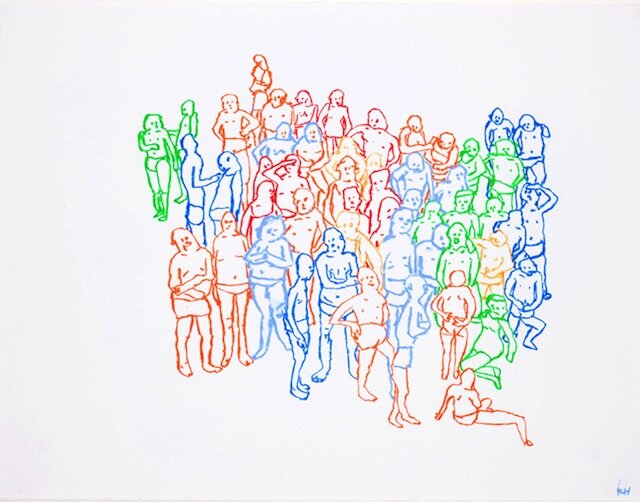
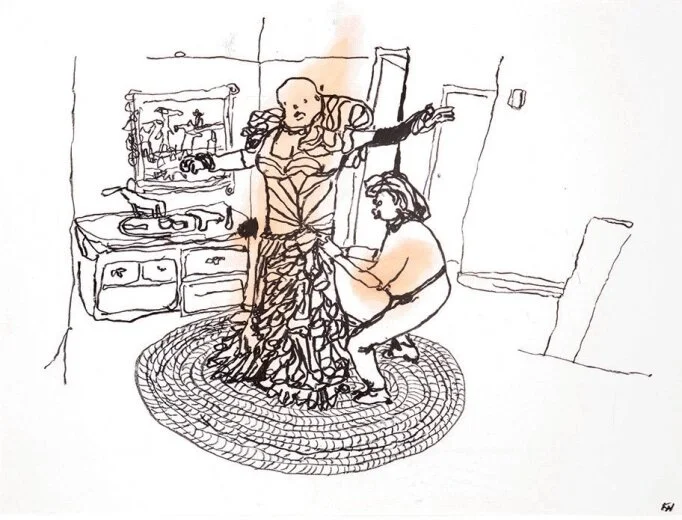
The paper and oil stick works are informed by mythology and her formative years in the lush woods of Massachusetts. The figures are simple, but Henderson’s deft ability with line and color bring an emotional heft to the faces and movements of the people in her drawings.

Art in America: Beastly and Banal: Kathleen Henderson at Track 16

By Leah Ollman, July 6, 2022 5:36pm

Kathleen Henderson
“Bluebeard and Other Poolings”
Track 16
May 14 to July 2, 2022

Read the full Art in America article here.

Kathleen Henderson draws in oil stick, applying medium to paper with a degree of pressure that conveys more than mere tonal emphasis. Her line is dense, agitated, driven by dismay and biting, desperate humor. Henderson has been drawing her way through nearly 30 years of exasperation at this country’s political corruption, military operations, environmental degradation, and social unrest, creating a devastating register of human folly and wrongdoing. Recently on view at Track 16 in Los Angeles, her new work, nearly 40 drawings made during the fraught pandemic year of 2021, features an evolving cast of ruggedly outlined figures in compromising, complicit, or otherwise revealing scenarios, and is among her toughest and most incisive.

Henderson often references ancient myths or folk narratives to critique contemporary abuses of power; in a selection of drawings here, she reaches for the centuries-old French tale of Bluebeard. The original character, a wealthy man with notably unattractive facial hair, marries and murders a succession of women until the latest wife discovers his gruesome stash of bodies and manages to escape. In Henderson’s hands, Bluebeard is a toxic everyman, an egregious all-purpose exploiter. In Running for School Board, she tacks conspicuous, messy blue triangles onto the faces of three parading candidates, providing a public service announcement of sorts by visibly disclosing their ill intent, perhaps the sort of retrogressive, book-banning agenda strategically absent from the campaign materials of ultraconservatives. In another piece, Blowing Bluebeard, figures line up obsequiously to perform sexual favors on the dumb blue brute, rendered, like many populating Henderson’s troubled cosmos, as an upright, limbless blob, little more than a phallus granted mobility and agency.

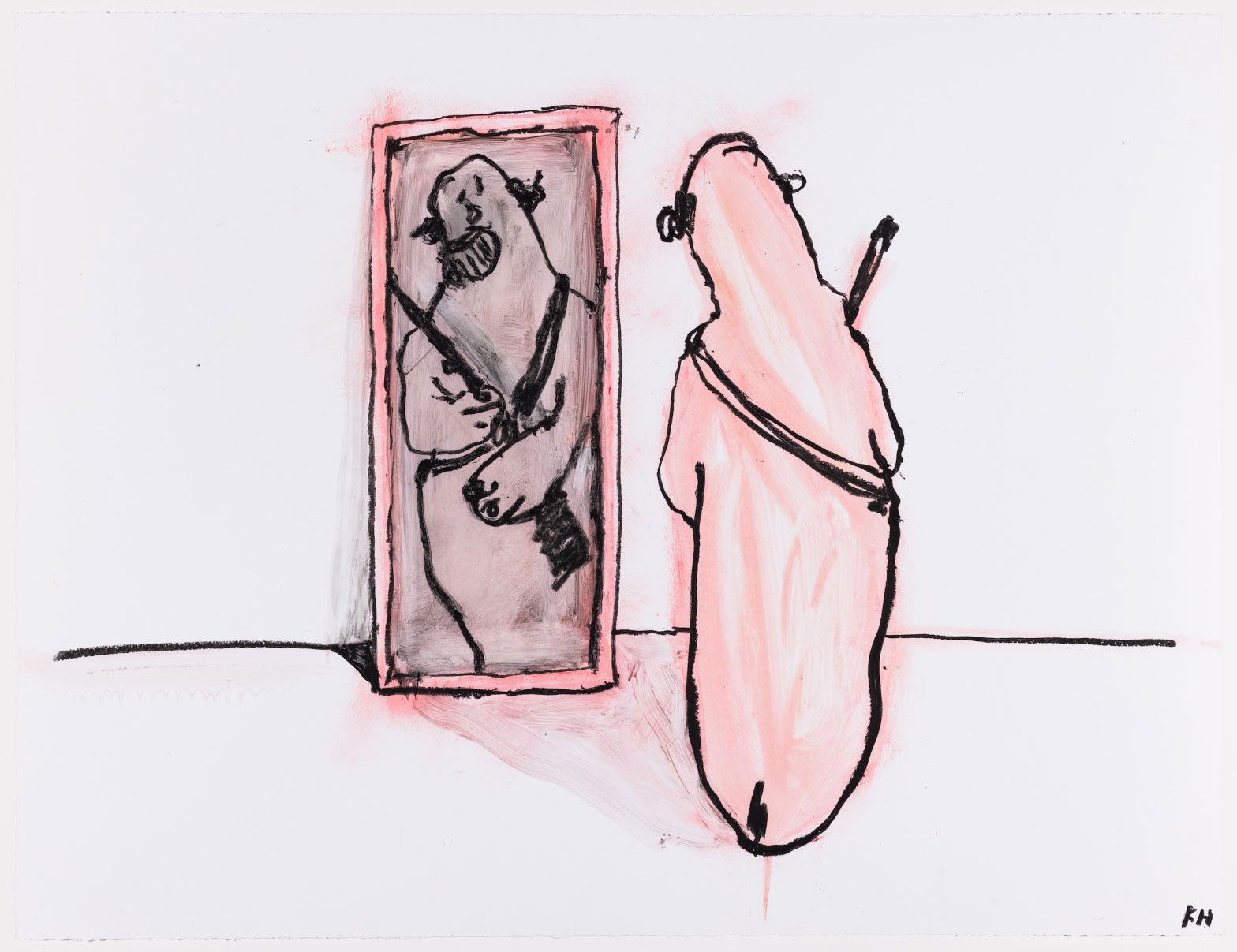
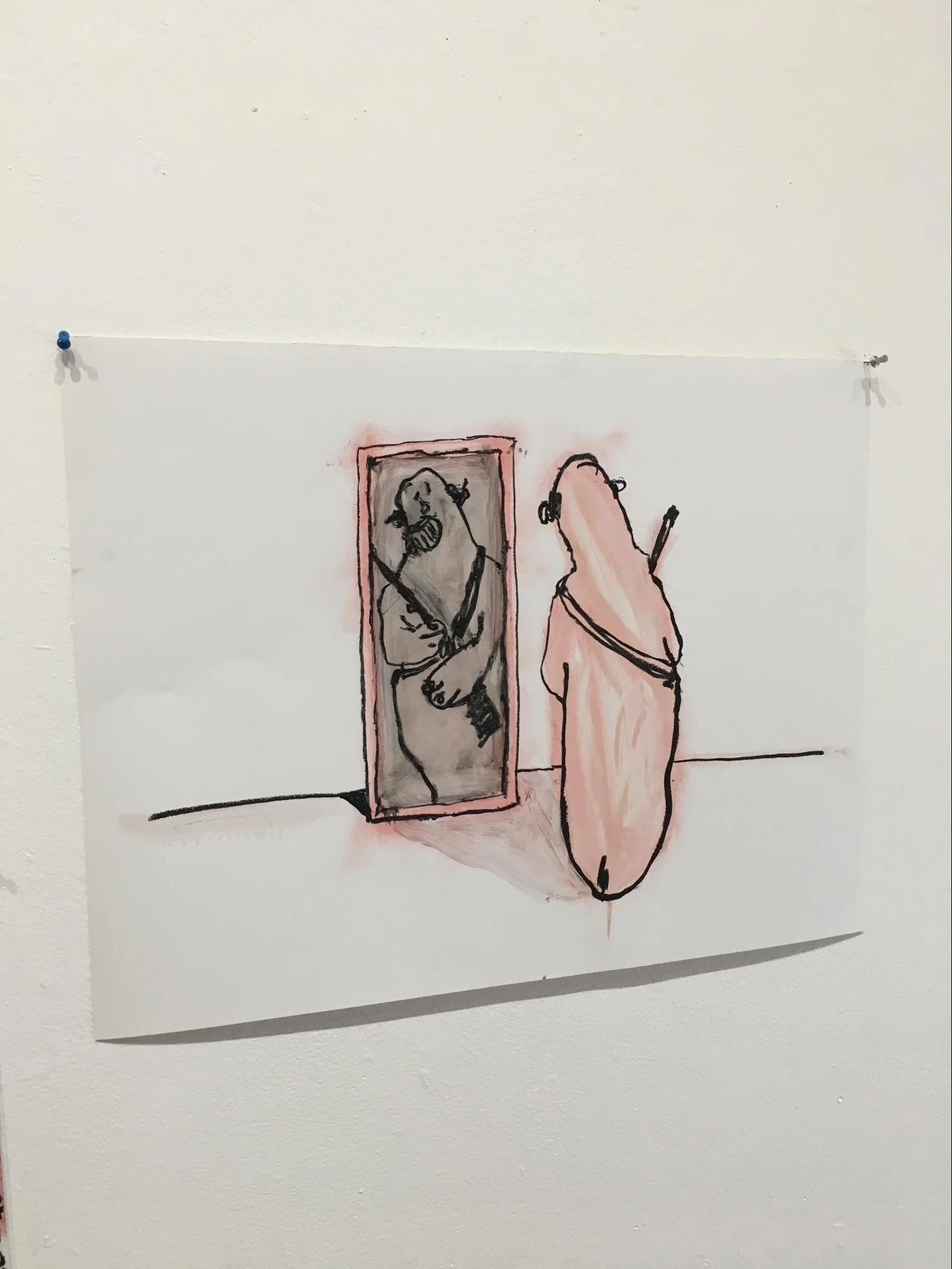
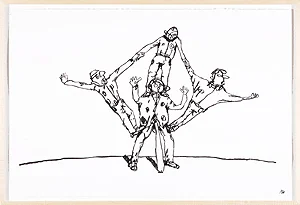
Across her oeuvre, humans do appear in conventional bodies, but more often they assume a range of shapeless shapes: cartoonish ghosts, hooded torture victims, costumed mummers, lumpy descendants of Philip Guston’s Klansmen. Henderson’s fiercely insistent black and red line, augmented by smeary, sickly yellows, greens, and pinks, circumscribes beings who lack spines and usually ears, too, the very physical features that emblematize conscience and empathy. No matter the depersonalized disguises, true, naked selves emerge via setting, action, or expression. Typically, these ruthless, guileless souls are caught inflicting some kind of damage (on others, the planet, democracy), claiming unearned authority, or displaying outsize pride. Drilling down on domination and the self-satisfaction it breeds, in Cage, Henderson pictures two men in what could pass as a captivity infomercial: one models the barely-big-enough trap and the other grins in unconcealed delight. In Pinkie, a large-mitted lump of a guy with an imposing weapon strapped across his chest preens before a mirror. And in the viscerally disturbing Yellow Light, Henderson bathes an incongruously smiling figure, rope-bound to a chair, in a cone of glowing gold.

Actual beasts are sprinkled throughout Henderson’s scenes, but only the humans appear beastly, and their cruelty is utterly banal. On the spectrum of social commentary, Henderson lands somewhere between Aesop and op-ed. She oscillates between ancient sources and contemporary manifestations, generalizing jabs and event-specific takes on vanity and the sorrier aspects of human nature. Among her closest compatriots are José-Guadalupe Posada and James Ensor.

Henderson’s work hinges on her fascination with how we see and present ourselves. She places figures before mirrors and crouching over puddles and pools, hungry for the validation of their own reflection. She satirizes, albeit bleakly, how the human instinct to preserve and witness has morphed in the era of mass communication and malignant individualism into a compulsion to document and broadcast our every move. Cameras and microphones abound in these scenes; nearly every activity has become either a performance or a press event. Boom carries this phenomenon to its darkest extreme, depicting the filming of a staged suicide. The victim, gun in mouth; the camera operator; and the holder of the boom mic stand on a curved stage, a globe the color of diluted blood. This is us, Henderson rages, producing and starring in a kind of collective snuff film, an arousing, real-time record of our own demise.

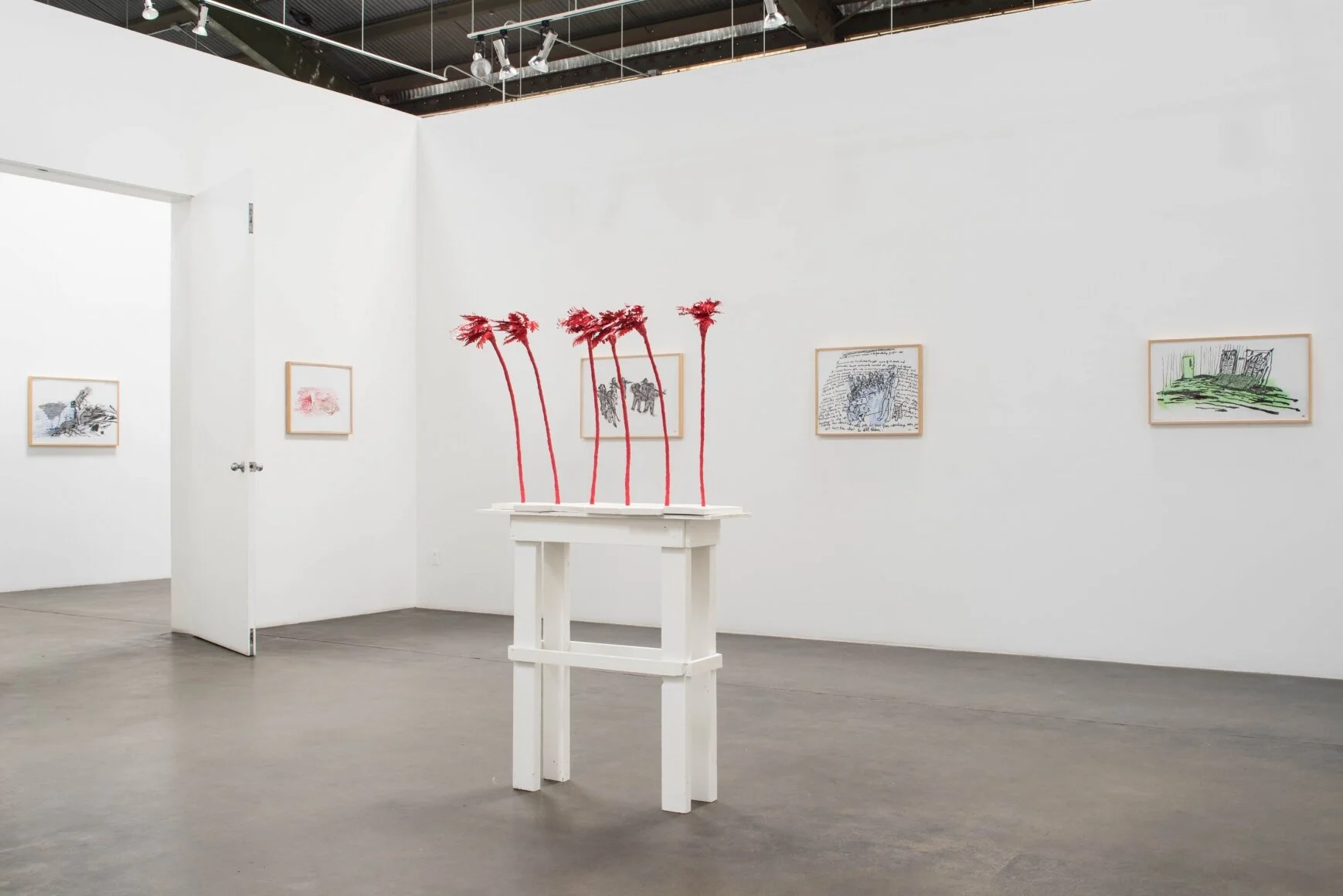
Her shaggy, urgent line is matched by rudimentary forms in a group of tabletop sculptures made in wax the color of dried meat (all 2022). Provisionally patched and pressed together, the figures, less than a foot high, have protruding noses, gaping mouths, buggy eyes, and arms akimbo. They look like escapees from a disturbing fairy tale. However exaggerated and distorted, Henderson’s works reveal the way things are as a means of exerting pressure to make them different. She once wrote across a drawing of an awkward fowl, “What if I could draw a bird / that could change the world? / in a good way, I mean / in a good way. / I know this is not that bird. / I know that.” Her wish declared, and its unattainability assumed, she has pressed on, making work that is increasingly, painfully relevant.

See the article here.

Bluebeard and Other Poolings in Hyperallergic

Your Concise Los Angeles Art Guide for June 2022 by Caroline Ellen Liou, May 31, 2022

Kathleen Henderson: Bluebeard and Other Poolings

Kathleen Henderson, “Pinkie” (2021), oil stick and oil on paper, 18 1/2 x 24 1/4 inches framed (image courtesy the artist and Track 16 Gallery, Los Angeles)

When: through July 2
Where: Track 16 Gallery (Bendix Building, 1206 Maple Avenue, Suite 1005, Downtown, Los Angeles)

Speaking of Guston, the works in Kathleen Henderson: Bluebeard and Other Poolings are somewhat reminiscent of Guston’s cartoons — sad and weird and scribbly and poignant, with the kind of raw immediacy that only drawing can convey. The show tackles US political issues of recent years head-on, Henderson’s innocuous blob faces somehow deeply revealing of the interiority of America.

Read in Hyperallergic

Kathleen Henderson at 18th Street, by Jessica Hough

Kathleen Henderson at 18th Street

By Jessica Hough

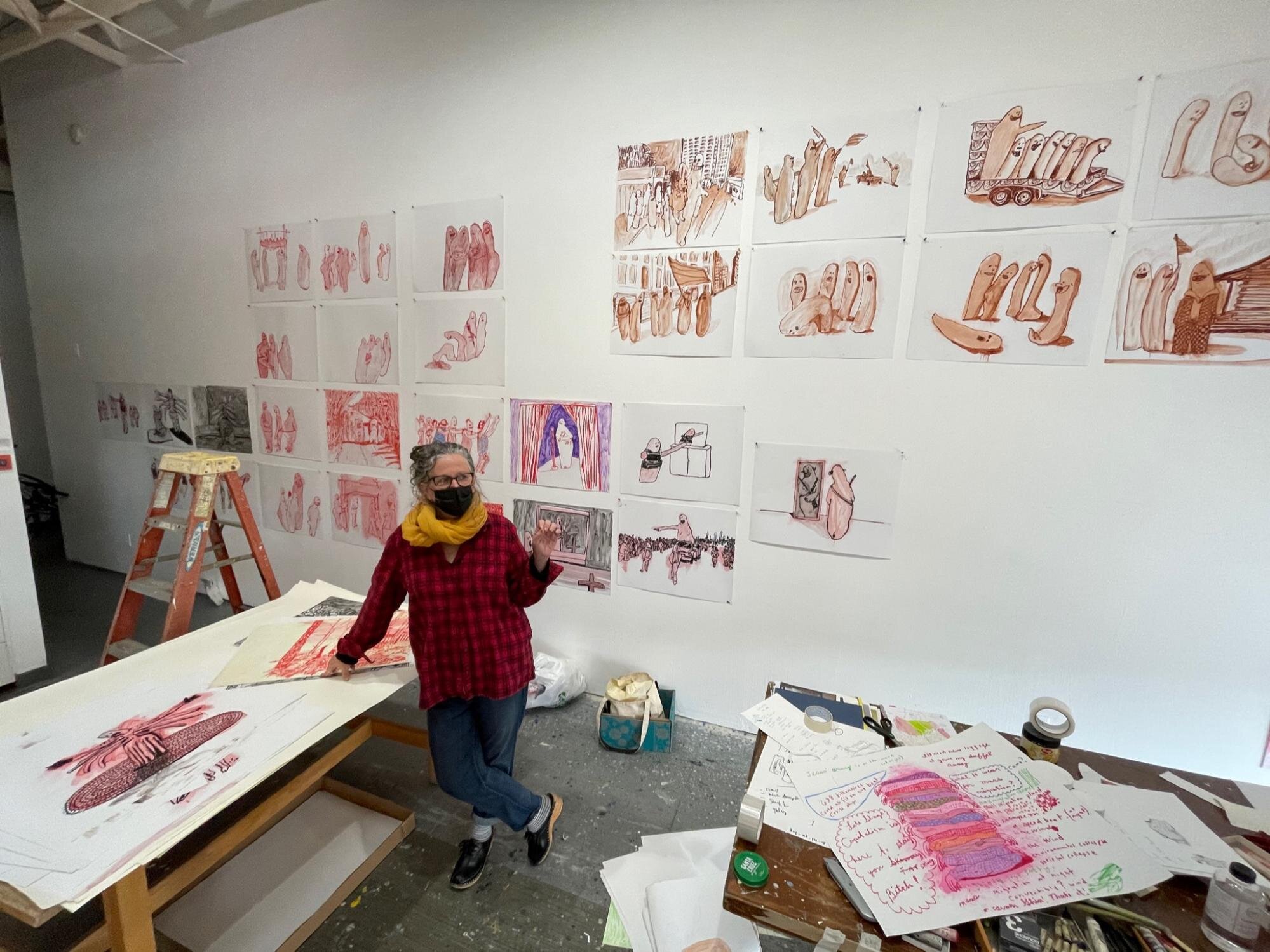
Kathleen Henderson in her studio at 18th Street Art Center in January 2021. Photo: Sean Meredith.

Kathleen Henderson in her studio at 18th Street Art Center in January 2021. Photo: Sean Meredith.

On January 6 when news alerts lit up our smartphones that rioters had breached the Capitol building, Kathleen Henderson’s studio at 18th Street Art Center was already crowded with goons. They had followed her, as they always do, and were taking shape on her easel and in drawings hanging four rows high.  

For close to twenty years, Henderson has been giving form to characters with a doughy human-like shape but vacant eyes and gruesome smiles. These blobby phantoms, rendered in oil stick on paper, inhabit corporate offices and take the stage at large events. They carry guns and stumble through forests meddling with wild animals. They limp along in a human-ish way but embody only our lesser qualities: narcissism, a mob mindset, and a blind appetite for power. Henserson’s surrogates expose these human qualities that spell our doom. “The problem is us. It's hard to solve,” she says during my visit.

image2.jpg

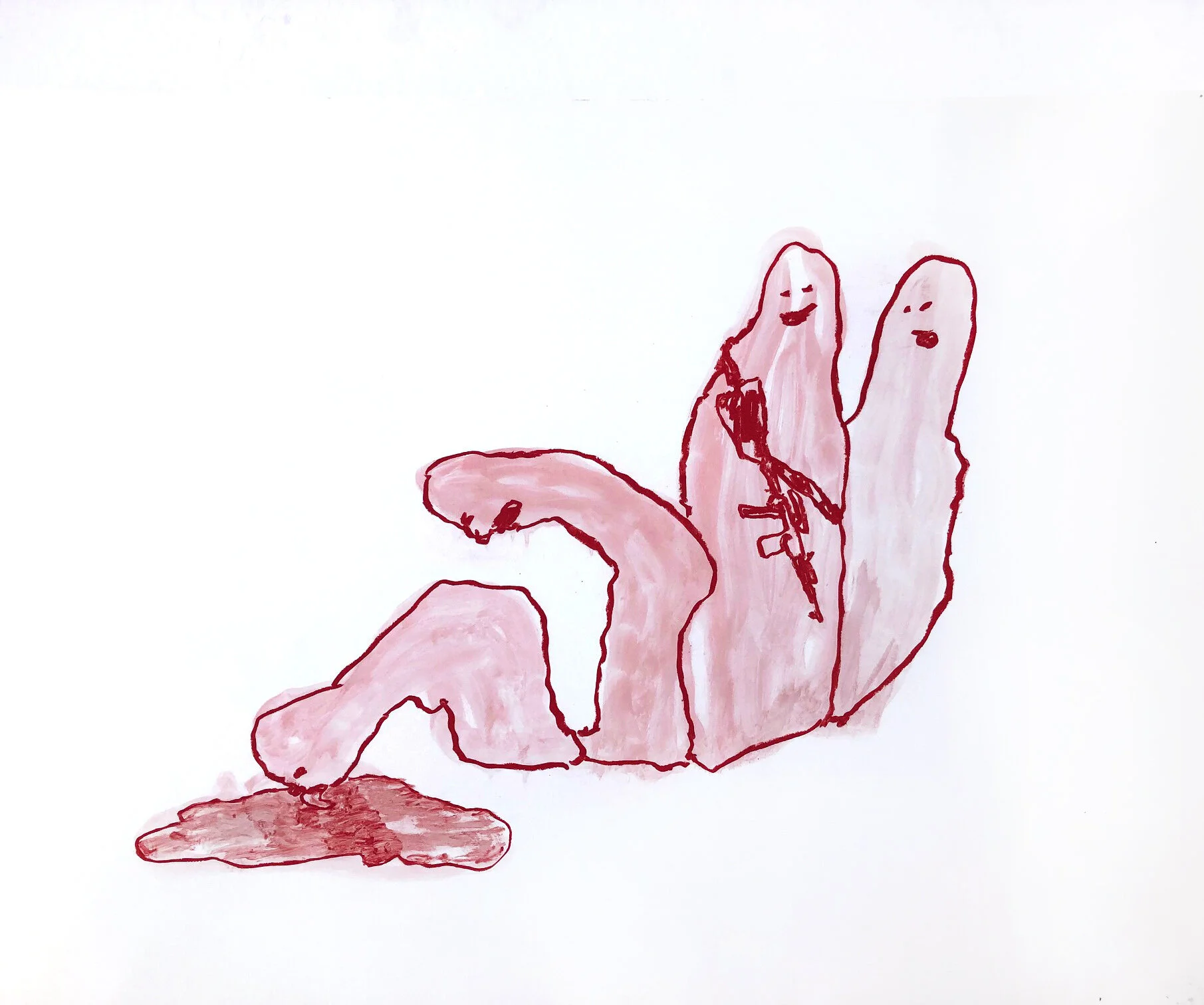
 I’ve been following Henderson’s work for a dozen years, and on that January day when I clicked through to footage of a mob pushing through police barricades and saw photos of men clamoring through the broken windows of our Capitol, it seemed to me that Henderson’s drawings had finally come to life. Dressed in thick quilted coats and knit caps that softened the shapes of their bodies, carrying weapons and flags, and costumed in furs and horns, I saw the goons that Henderson has been cautioning us against.

Henderson jokingly refers to her time at 18th Street as her “doomsday residency”; first with Covid to contend with, followed by the attempted coup. The usual camaraderie of the Santa Monica studios was replaced during this time with an unsettling quiet that kept her frightened by the noise of the building settling at night, and the muffled voices of people passing on the sidewalk outside her studio. Many of us were paralyzed witnessing the Capitol siege, and Henderson too was initially struck into stillness. But she routinely makes work that operates in the space of doomsday. So in the end, her residency at 18th Street turned into a generative time. Working with news radio playing in the background, this latest crisis was telegraphed through her hand in drawing after drawing.

image5.jpg

Unaccustomed to having long uninterrupted periods at her easel, she found herself reading and writing during much of the daytime. In the evening, when her ideas were stored up, even pent up in her mind, she released them to paper.  “So much of making art is like a transference of energy,” she tells me, and that energy needs to build. Henderson’s drawings are electrified by the jerky quality of her line work. It animates her characters, and delivers a discomforting tenor to the viewer.

The drawings look like they’ve been made quickly and they have, but her process is one where she makes drawing after drawing until she feels she’s gotten it right. She tears up the ones that she feels aren’t working. “I know when I don’t have it,” she says. Lifting the lid of a ream of paper she brought with her, only a few remain of the 100 sheets she started with. At home, her easel sits in a corner of her cramped bedroom with finished drawings going into a box under her bed with little possibility of being evaluated in the moment. The vast studio at 18th Street allowed her space to pin the works up, look at them in relation to each other, and consider them as she went. This was an indulgence that fed her productivity.

image3.jpg

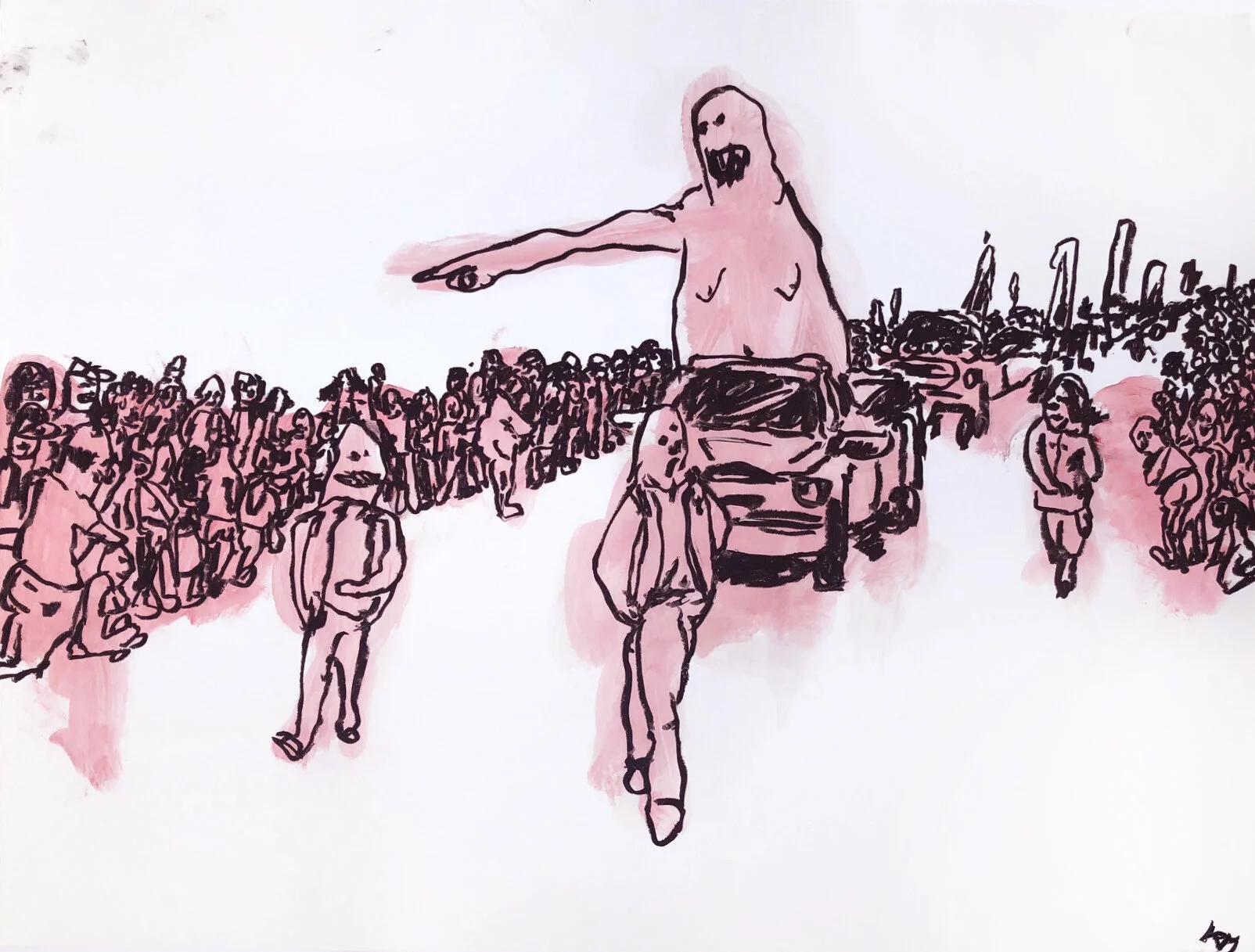
In one drawing, a massive blob man with saggy breasts rides along a parade route bolstered by the energy of the crowd. His naked form rises up from an open top vehicle; his mouth agape. But the dominant gesture is the stiffened arm pointing with violent accusation to someone in the crowd. It’s not hard to imagine who Henderson might be describing. These human stand-ins get their power, in part, from conspiring, whispering, gathering in groups. And in Henderson’s drawings, they appear to go unchallenged.

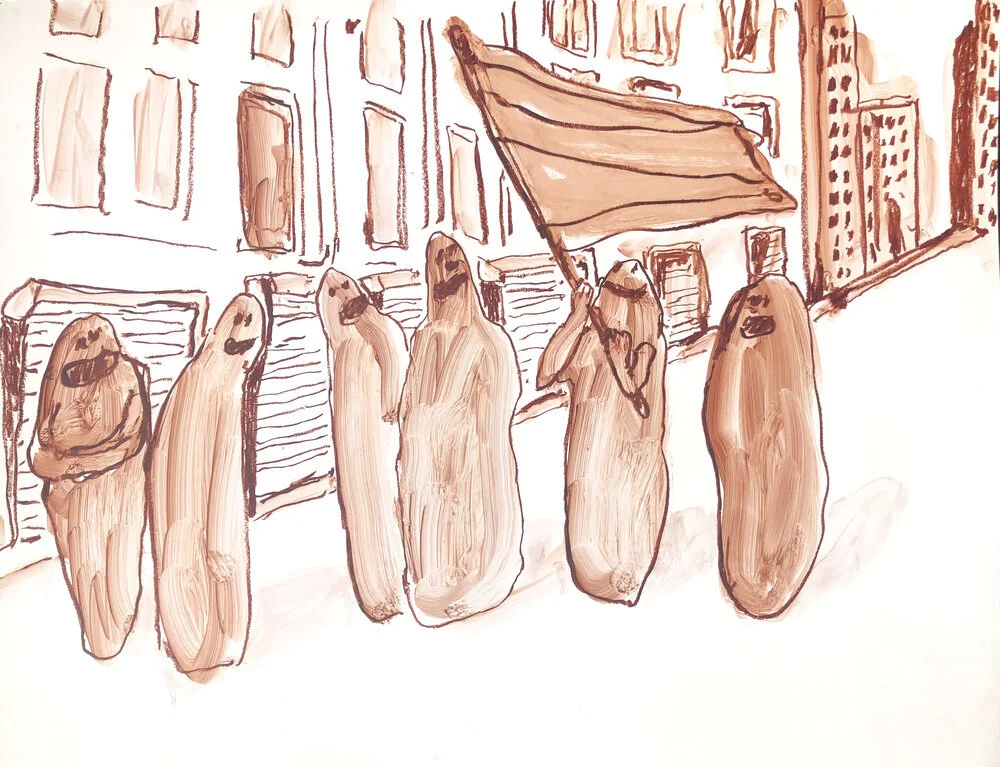
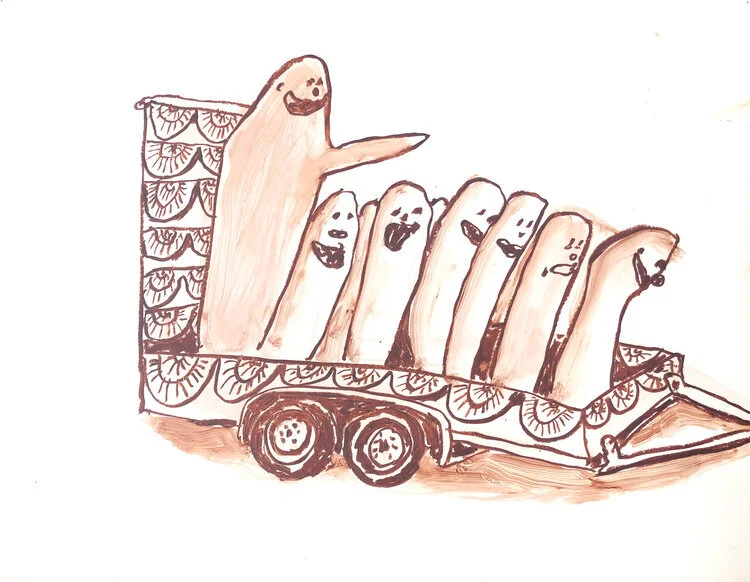
Some of the characters that took shape during her residency are reduced to an even simpler form--empty, oblong shmoos. Unclothed, they are turds or “shits” (which is how Henderson describes them). In one drawing, a parade float draped in festive bunting that you might expect to carry a small-town elected official and a handful of girl scouts is instead tightly packed with smiling turds. Parading, flag waving, (and pointing) runs through these new works; the superficial elements of leadership.

image1.jpg

Henderson’s work uses satire but the critique is so broad as to encompass us all. Her drawings are funny but only for the split second they need to disarm you, before they burn and weigh on your conscience. We smile until we know that they’re about us. In another drawing, an armed turd ponders his reflection, easily reminding us of the selfies insurgents posted to social media to memorialize their violent invasion of the Capitol. The turd isn’t me, you think. But it is.

image6.jpg


LA Times art review: Villain or victim? Comic or tragic? The unsettling art of Kathleen Henderson

Leah Ollman, Review: Villain or victim? Comic or tragic?
The unsettling art of Kathleen Henderson, LA Times, Jan. 2020

By LEAH OLLMAN
JAN. 14, 2020 7 AM PT

We aren’t beauties, we humans. At least not on the inside, not always. Kathleen Henderson practices an excruciating realism when it comes to our species. In 35 blistering recent drawings at Track 16, greed, pride and vanity play out in oil stick on paper — raw impulses matched by raw, urgent line.

Henderson, based in the Bay Area, hasn’t shown in L.A. for five years. Much has happened since then. In scene after tragicomic scene, Henderson registers the dismaying state of the union and the planet.

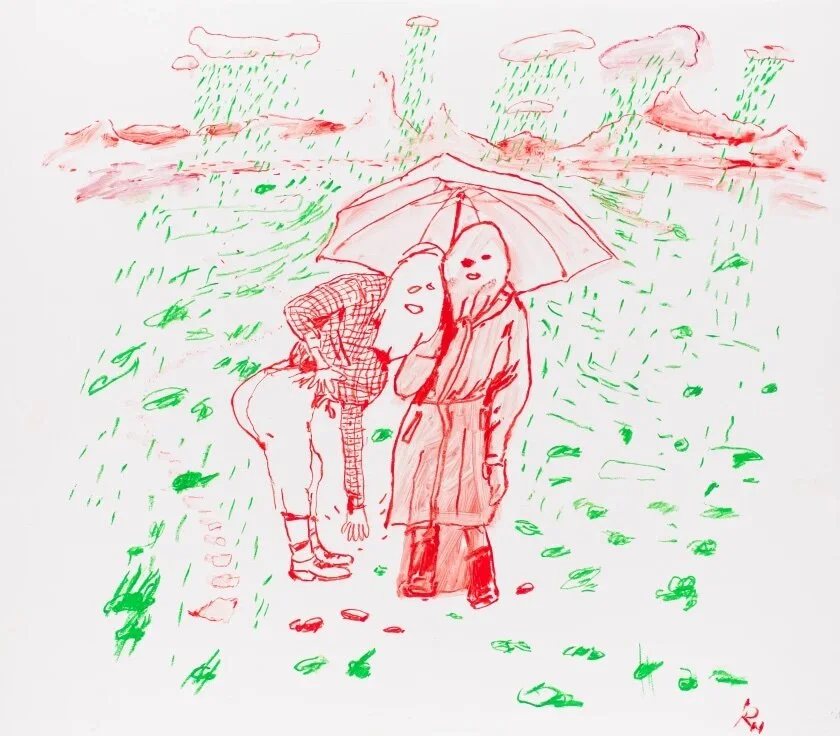
Two figures under an umbrella pose as if for a classic, nature-as-souvenir snapshot made comic by one woman’s awkward-sexy stance and made tragic by the green rain spit down from the clouds, the drops curdling into clots that litter the bare ground.

In “Team Building With Rabbits,” a man wears nothing below the waist, jacket and tie above, and on his face a dumb grin of self-congratulation over the carcasses clutched in each hand.

Henderson toggles astutely between representing concealment and revelation, power and vulnerability; sometimes the conditions oppose each other, sometimes they reinforce.

Most of her subjects, for instance, are hooded, their heads reduced to lumpy white domes with clumsily cut-out eyes and mouths. But those overly simplified features read also as unguarded, brutally transparent expressions. Henderson has referred to mummers’ costumes as a source of the hoods, but the cloth covering carries multiple and varied associations, from innocent Halloween ghost to devious criminal or torture victim. The drawings derive a distinctive, searing energy from that constant oscillation.

Henderson borrows not just from popular culture but also history and myth to render the tainted spirit of the here and now. A current favorite is the ancient Greek goddess Artemis of Ephesus, a protector of mothers, traditionally portrayed with a chest barnacled by breasts. Henderson shows her naked, onstage, before a curtain drawn as if of streaked blood — again, strength and vulnerability uneasily fused.

Many of the characters appear at microphones, engaging in some sort of public address, or posing with their conquests. Like good 21st century citizens, they are at once performing and exposing themselves, through the masking device of persona.

Are we doomed? Perhaps, perhaps not. But ridiculous creatures we most definitely are. Henderson allows for levity and also tenderness, even if skewed: A man kneels to kiss a dismayed ghost, outlined in red on the ground; the self-loving Narcissus is drawn as an earnest clown.

Henderson’s work might be pared down, but it is sociologically dense. Her palette of dilute pinks and greens verges on the sickly. Her line is insistent. Like the figures it circumscribes, it flaunts an innate lack of grace.

As with the mummers, her model too may be the Greek god Momus, who personified mockery and blame, exercising an essential role as social critic. According to one of Aesop’s fables, Momus faulted the design of the human body for hiding the heart inside. It should be visible, he felt, the better to detect its corruption. Henderson too believes in exposing humankind’s base motivations — exploitation, domination — and does so brilliantly, whether stripping her characters or cloaking them.

Kathleen Henderson
Where: Track 16, 1206 Maple Ave.. No. 1005, L.A.
When: Wednesdays-Saturdays; ends Feb. 1
Info: (310) 815-8080, track16.com

ArtNow LA art review: Kathleen Henderson: ‘Watch Me Make You Disappear’

Kathleen Henderson: ‘Watch Me Make You Disappear’
Expressing the Dire State of Our World
by Jody Zellen

Kathleen Henderson
Watch Me Make You Disappear
Track 16
January 4 – February 1, 2020

Kathleen Henderson has a facile hand and a keen wit. She mines the news media for content and rather than make didactic and preachy work about the state of the world, she offers humorous interpretations of these troubling times. Her oil stick and oil on paper works have a gestural urgency and her thick strokes suggest her characters, rather than render them realistically. In the past, the drawings were black oil-stick outlines on white paper but now her palette has expanded and many of the works have pink and green lines and shading, as well as brushed background tonalities. The latest drawings depict nude and hooded figures, animals, office spaces and political events with and without speakers. There are also images that suggest the unpredictability of nature and the changing climate.

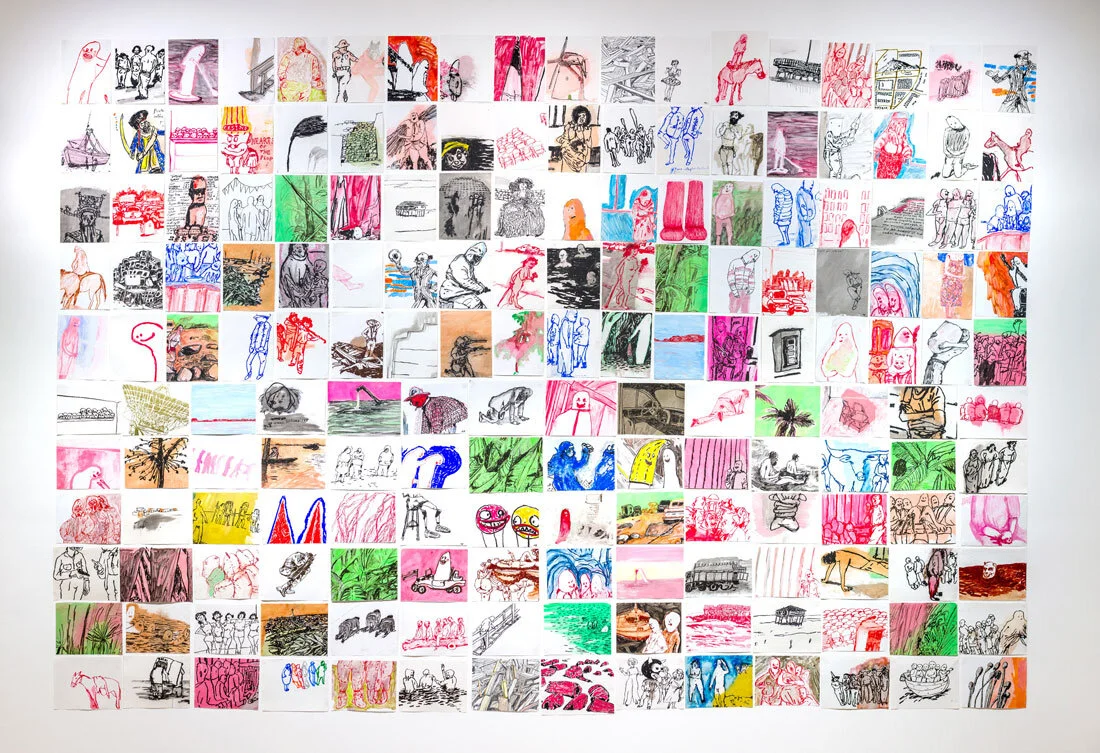
Henderson’s deadpan titles make reference to the work’s content yet are often more metaphoric than specific. For example, Mushroom Cloud Party Hat Party (2019) pictures a smiling, multi-breasted Venus of Willendorf-esque figure in mid-jump in front of a stone wall and a distant urban landscape with a green-toned sky. Scrawled on the wall are the words: mushroom/cloud/party/hat./party. The who, what, when and why remain a mystery. This ambiguous figure also makes an appearance in Artemis of Ephesus on Stage (2019), as well as in many of Henderson’s out-takes, smaller (8 1/2 x 11 inch) works presented as a large grid in the back room of the gallery. Within this seductive and engaging presentation are crudely drawn prisoners, the devastation of hurricanes, masked men with guns, crowds, politicians, skeletons and oil rigs.

The cumulative effect of viewing these 150-plus works on paper is like mainlining a year of news, taking in the foils, destruction and ruin through a sigh of disbelief. In many ways, Henderson’s out-takes function as the index, opening possibilities for the creation of relationships and finding similarities between the larger and smaller works. Though not studies in the traditional sense, the out-takes represent the expansive nature of Henderson’s undertaking.

Henderson’s work speaks directly to the moment. She is not shy about expressing her political beliefs and pointing a finger at the absurdities within the current administration. While there are moments of reflection like in Kiss, where a figure leans over to kiss the ground or Narcissus in which a figure confronts his reflection, the overall effect of the exhibition is an expression of the dire state of our world.

See the article here.

— Jody Zellen is a Santa Monica-based artist and writer. She has been writing art reviews for more than 25 years and currently contributes to Artillery, ArtScene, Afterimage and Art and Cake. For more information on her art and writings please visit www.jodyzellen.com

Hyperallergic - ArtRx LA by Matt Stromberg October 14, 2014

Kathleen Henderson
When: Opens Saturday, October 18, 2014 5–7pm
Where: Rosamund Felsen Gallery (Bergamot Station B4, 2525 Michigan Avenue, Santa Monica)

Kathleen Henderson, “I Went There Looking For a Man Whom I Heard Lived By the Most Agreeable Occupation #1,” oil stick on paper (via rosamundfelsen.com)

Kathleen Henderson, “I Went There Looking For a Man Whom I Heard Lived By the Most Agreeable Occupation #1,” oil stick on paper (via rosamundfelsen.com)

Kathleen Henderson‘s oil-stick drawings crudely and colorfully convey a sense of contemporary alienation. Even when they are full of people, a sense of isolation prevails. Her latest body of work opening this Saturday at Rosamund Felsen “confronts head-on the financial sector and its place in a system of gross inequalities; the excess and waste of massively expensive and tragically useless trophy projects, or ‘white elephants’; and a profiteering pharmaceutical industry that is moving beyond marketing drugs to humans and setting their sights on neurotic and depressed domestic animals as well.”

ARTFORUM, critic’s picks

Sharon Mizota, Critic’s Pick, Artforum.com, Nov. 2008

LOS ANGELES
Kathleen Henderson
ROSAMUND FELSEN GALLERY
1923 S Santa Fe Ave #100
November 15–December 20, 2008

Kathleen Henderson’s exhibition of drawings and sculptures, titled “I Shew You a Mystery,” evokes the peculiarly American concoction of hope and fear, faith and desperation, that filled many nineteenth-century Christian revivalist meetings. Yet her spare, casual oil-stick drawings and lumpy, scatological sculptures are resolutely of the present, depicting a world still uncomfortable with itself: bellicose, juvenile, a bit confused, and often touchingly vulnerable. The drawings depict hooded figures (usually men) and cheeky satyrs in scenarios that are alternately ominous, tender, and darkly humorous. A man aims a rifle in front of a wooden shack; another is chained spread-eagle to a wheel. Other figures pray, hold hands, or waltz together awkwardly, and in one of the more bizarre examples, a dark-haired man helps a skinny hooded figure to direct his penis, which snakes out of his shorts like an umbilical cord, to the toilet. This mix of menace, comedy, and pathos is reminiscent of Philip Guston’s Klan paintings, but Henderson’s work is perhaps closer to the arch comic-book style of Raymond Pettibon, who shares her black sense of humor and eclectic, often outré subject matter.

Speaking of which, penises—both literal and symbolic—crop up throughout the show, signaling an irreverent fascination with the myths and pratfalls of manhood. This impression is reinforced by images of Pan, the horned Greek god, considered both a symbol of virility and a model for depictions of Satan. One paper-pulp-and-tar sculpture depicts Pan with a drooping phallus that isn’t nearly as long as his curling, rigid beard. This displacement of male potency undergirds the entire exhibition, revealing the misdirected masculinity at the heart of these chaotic, anxious times. The drawing Untitled (taping man), 2008, is a frighteningly succinct example: Two figures fasten a third to a board with strips of tape and hang him upside down. It’s a scene straight out of Jackass or, perhaps, Guantánamo Bay.

Read the article here.

NY Times, The listings, Aug. 14th, 2009, H. Cotter

KATHLEEN HENDERSON: 'WHAT IF I COULD DRAW A BIRD THAT COULD CHANGE THE WORLD?'
This beautiful and chilling show of oil stick drawings is like a fairy tale version of Abu Ghraib as drawn by Ben Shahn. Torture is in progress; Hitler tries his wings; men with bags for heads hunt animals but may be animals themselves; a fat bird flies by, trailing the words, ''If I could draw a bird that could change the world? In a good way, I mean. In a good way.'' The Drawing Center, the Drawing Room, 35 Wooster Street, SoHo, (212) 219-2166, drawingcenter.org; closes on Thursday. (Cotter)